

In the evolving landscape of industrial automation, precise speed control and stable operation of low-speed motors are pivotal. Hall sensors play an indispensable role in achieving these goals, especially in compact 5-inch motor applications widely used in smart devices and small-scale machinery. This article delves into the theoretical underpinnings and practical applications of Hall sensors, unraveling how magnetic field sensing translates into robust feedback loops that ensure quiet, accurate, and durable motor performance.
At its core, a Hall sensor is a transducer that responds to a magnetic field by producing a voltage output—known as the Hall voltage. This effect, first discovered by Edwin Hall in 1879, leverages the Lorentz force to separate charge carriers in a semiconductor material, generating a measurable electrical signal proportional to the perpendicular magnetic flux.
In the context of low-speed motors, Hall sensors are commonly integrated to detect rotor position and rotational speed. By strategically positioning these sensors in proximity to rotating magnets attached to the motor shaft, the sensor outputs a series of pulses corresponding to the passing magnetic poles. This digital output is critical in closed-loop speed control systems, offering precise feedback to the motor controller for real-time adjustments.
The Hall effect sensor operates on detecting changes in the magnetic field intensity generated by the rotor magnets. When the magnetic north or south poles pass near the sensor chip, the electrons in the semiconductor experience a directional force, creating a transverse voltage signal. This signal is then amplified and converted into a clean digital square wave representing the rotor's position and speed.
To simplify, imagine the sensor as a gatekeeper that counts each magnetic pole’s arrival, translating it into electronic pulses. A typical 5-inch motor with an integrated Hall sensor produces pulse frequencies linearly proportional to rotational speed, enabling speed resolution down to a few RPM (revolutions per minute)—a necessity for applications requiring subtle torque adjustments and noise reduction.
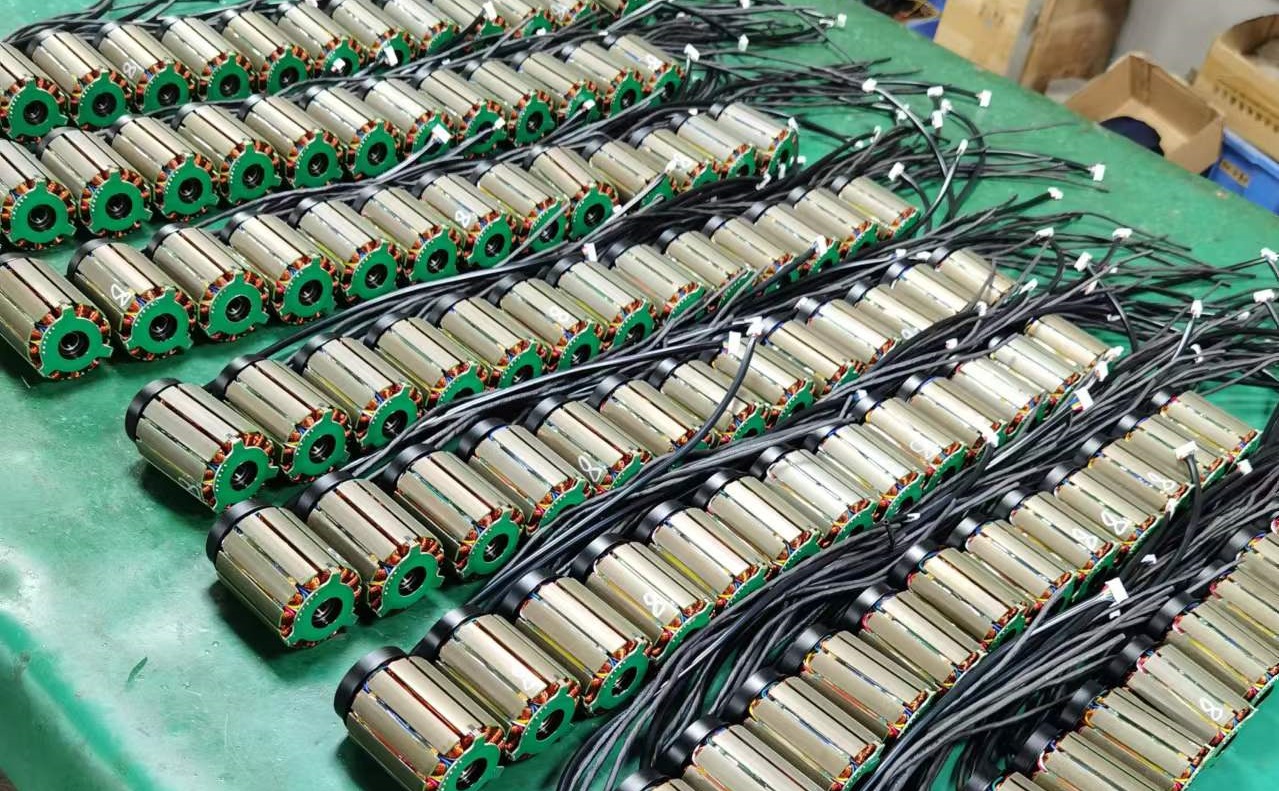
In closed-loop speed control systems, Hall sensors provide instant feedback to Electronic Speed Controllers (ESC), allowing them to adjust voltage and current for maintaining target speeds even under varying loads. This capability is critical in small automation devices such as robotics, drone motors, and precision conveyor belts, where fluctuations in speed can lead to performance degradation.
Moreover, position detection enabled by Hall sensors facilitates precise commutation in brushless DC motors (BLDC), minimizing torque ripple and mechanical vibrations. This translates directly to quieter operation and prolonged motor lifespan—qualities essential for environments demanding silent and durable equipment.
Despite their robustness, Hall sensors may encounter issues such as signal drift, loss of pulse output, or inconsistent feedback. Such faults often stem from:
Effective troubleshooting begins by verifying sensor signal consistency with an oscilloscope or logic analyzer, ensuring the magnetic target is positioned within specified air gaps (typically 0.5–2 mm), and confirming the sensor’s operating temperature falls within the rated range (-40°C to +125°C). Preventive maintenance and shielding improvements also enhance sensor longevity.
Shenzhen Jinhai Xin Control Co., Ltd. specializes in advanced Hall sensor solutions tailored for precision low-speed motor control. Their products emphasize ultra-low noise magnetic sensing, high signal-to-noise ratio outputs, and integrated temperature compensation algorithms to ensure steady operation under fluctuating industrial environments.
By incorporating these sensors, manufacturers gain enhanced control over motor dynamics—resulting in quieter devices, extended mechanical lifespan (often an increase of 20-30%), and improved energy efficiency through accurate speed adjustments.
"Accurate position and speed feedback from Hall sensors is the linchpin for optimizing brushless motor performance in precision equipment," said Dr. Leo Wang, a leading researcher in motor control systems at the International Automation Institute (IAI), underscoring industry consensus on the sensor’s value.


